

A new 2026 survey shows a clear disconnect surrounding how prepared supply chain (SC) orgs say they are for the rapidly increasing volatility in the market today. The survey results expose potentially serious capability gaps. As an example, many organizations today are not satisfied with their S&OP tech toolkit, but at the same time, only 7% of those surveyed reported using intelligent software that’s purpose-built for S&OP. Additionally, many employ processes and approaches that might be termed “analog” by comparison to the latest tools. Spreadsheets, generic ERP or BI systems, and monthly or even quarterly planning meetings/updates are common. This can leave companies unprepared to respond to rising volatility, whether or not they self-report readiness.
Additionally, the survey shows that when push comes to shove and supply chain managers have to choose between prioritizing efficiency and flexibility in their planning and supply chain management, they tend to anchor on efficiency. However, over the past few years, dramatically increasing volatility has exposed a heightened need for more intelligent, more flexible supply chain management (SCM) systems and approaches.
In this article we’re going to present some key discoveries of the survey that elaborate these potential capability gaps, and discuss why flexibility has become far more important in today’s environment.
Who: Gatepoint Research, in partnership with ORI and SCPI
When: Between September 2025 and January 2026
How many participants: 100+
What types of positions: A mix of CEOs, VPs, directors, and senior or department managers were asked via email to take a survey regarding challenges in supply chain operations. This diversity of respondents within supply chain and SC-adjacent positions integrates perspectives from both senior leadership and hands-on managers, ensuring the findings reflect organizations’ strategic priorities as well as day-to-day operational knowledge and experience.
From which industries: In descending order, the greatest number came from from F&B (food and beverage) manufacturing (66%), industrial/automotive/general manufacturing (17%), packaging containers and food supply infrastructure (12%), and ingredients, chemicals, and materials industries (5%).
From what size of orgs: The survey participants represent companies with annual revenues ranging from less than $250 million to those generating $1.5 billion or more.
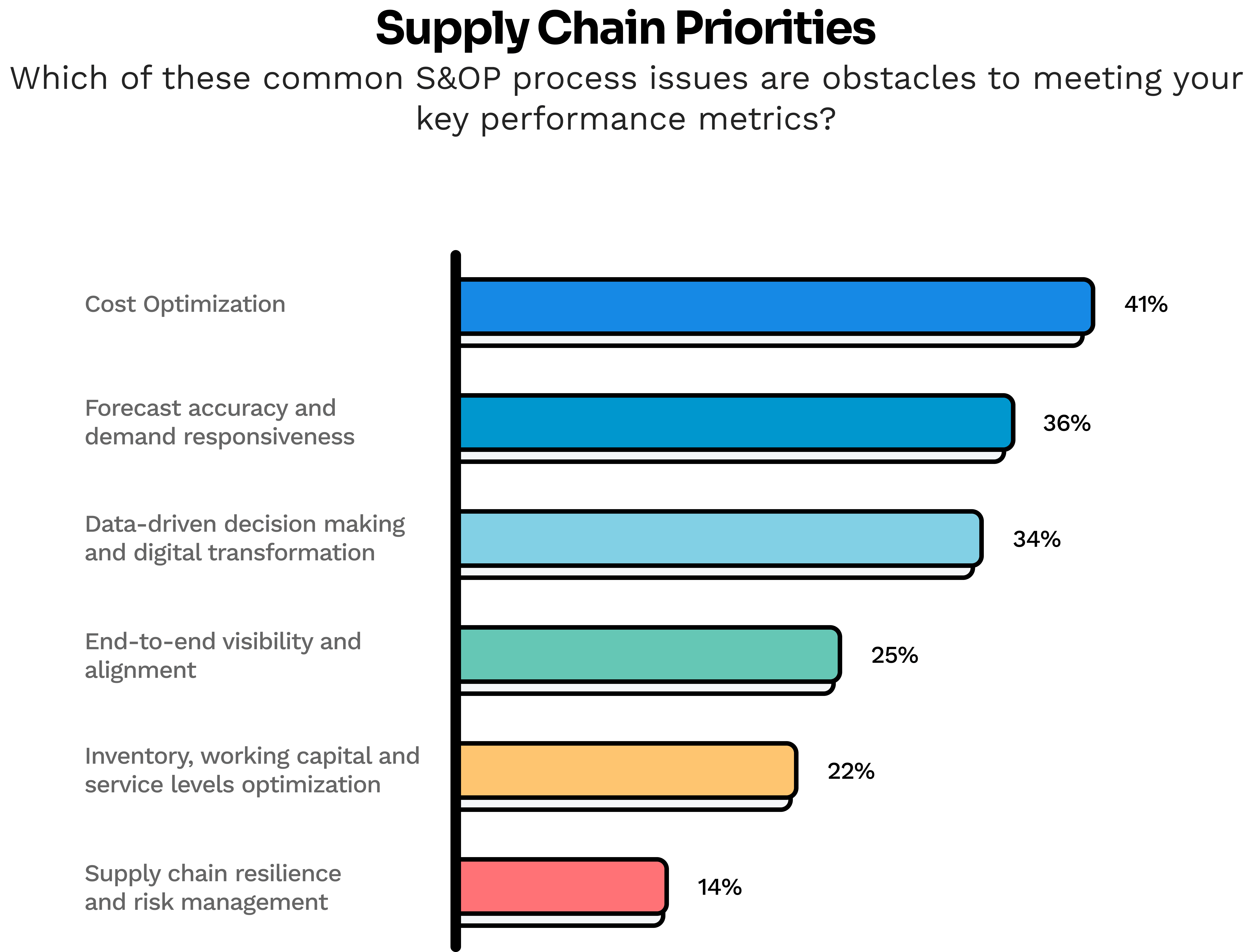
It’s not unexpected in pretty much any industry today to see that cost optimization is by far the most popular focus for improvement, and we can see that 41% of survey respondents chose it as their top priority. However, in a volatile supply chain environment, the remaining data in the graph above exposes some troubling realities. Everyone wants to optimize costs, but the supporting capabilities needed to achieve this goal are not being sufficiently prioritized.
For example, better forecasts (only 38% selected) would have significant impact on cost optimization, as would faster, data-driven decisions and digital transformation/execution (34%), but these are lower on the priority totem pole than cost optimization. At the bottom, a paltry 14% of participants chose improving supply chain resilience and managing risk as a top priority, though this should arguably be one of the primary focuses when preparing for an effective volatility response. Judging by the survey participants, these areas are underdeveloped across multiple industries, requiring dedicated improvement, or at least awareness and re-prioritization.
(Incidentally, cost optimization is also rated as the top priority for Chief Financial Officers according to a SAP survey in 2025: “The report finds that the top focus of finance leaders is cost-cutting to drive growth, based on survey responses from 350 chief financial officers and senior finance leaders across eight countries from December 2024 to January 2025. Additionally, nearly all those surveyed report success from using artificial intelligence (AI).” So, it shouldn’t be much of a surprise that SC teams and leaders are also keying in on cost optimization as their number-one focus. However, this must be buoyed up by an increased ability and priority to achieve better, more accurate, and more integrated forecasting and execution.)
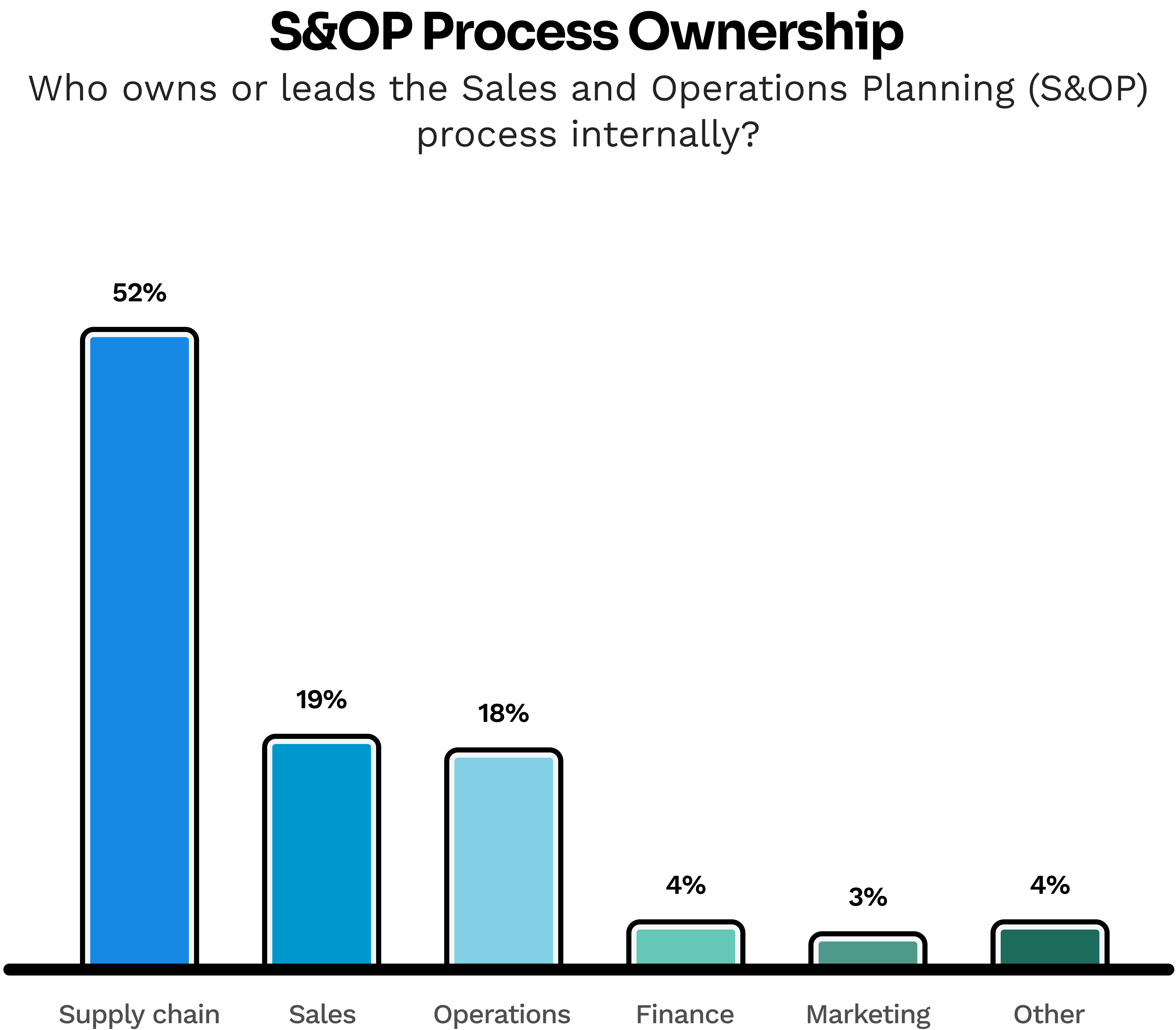
The vast majority of respondents indicated that their sales and operations planning process is owned or led by the supply chain team. Depending on your organization’s preference, leadership structure, and goals, this may or may not be a serious issue. However, when we look at the following responses on cross-function integration, we can see an underlying problem.
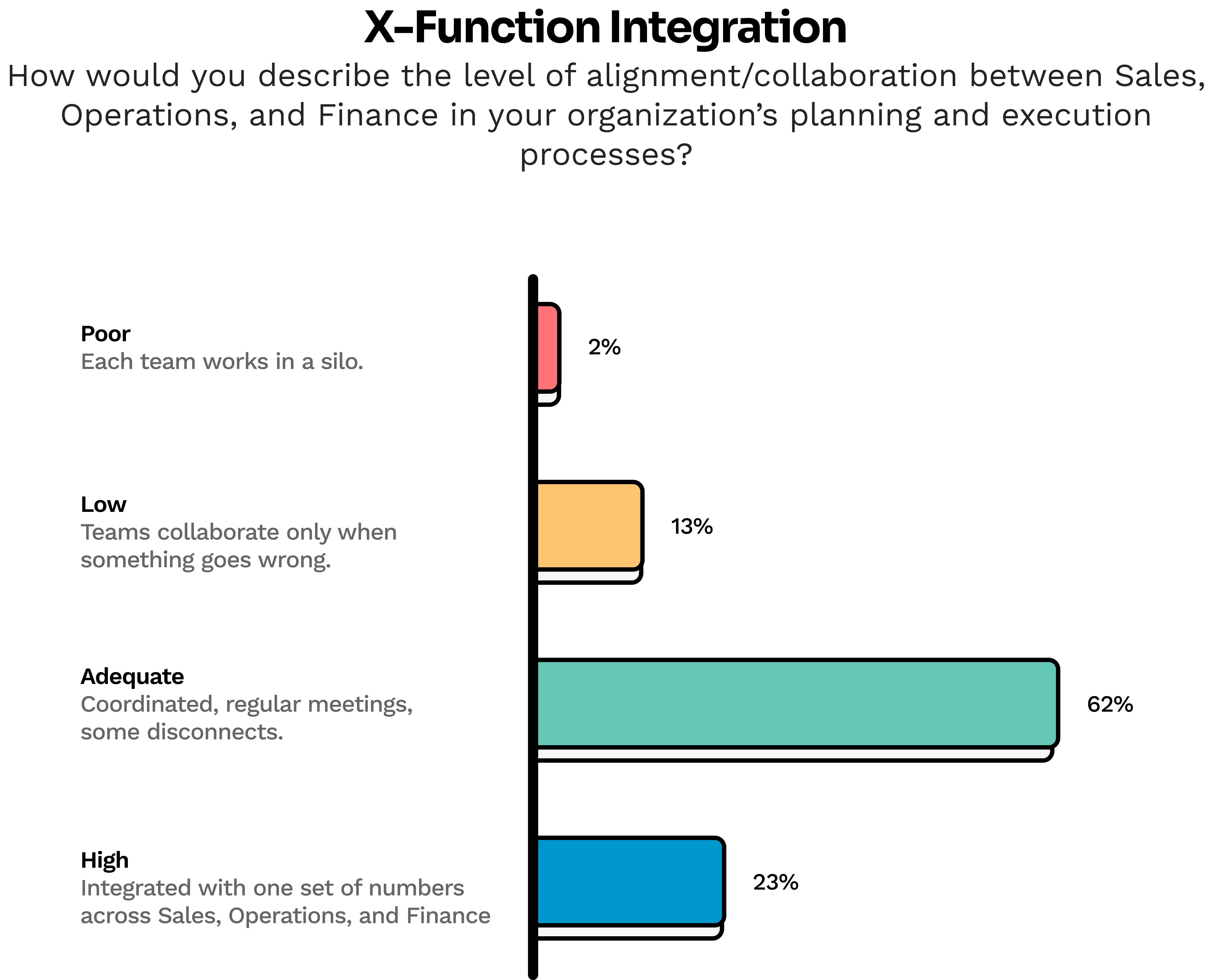
As you can see here, only 23% report highly integrated planning across Sales, Operations, and Finance—signaling that true cross-functional alignment is rare, though it should absolutely be the goal. In essence, most organizations are coordinating activity at best, but not actually synchronizing planning and vital decision-making. S&OP should be at the core of every aspect of the business, and cross-function integration must be a high priority for each team. This kind of integration and collaboration is facilitated by the best S&OP platforms and tools, but as we’ll see later, too few organizations are taking advantage of them.
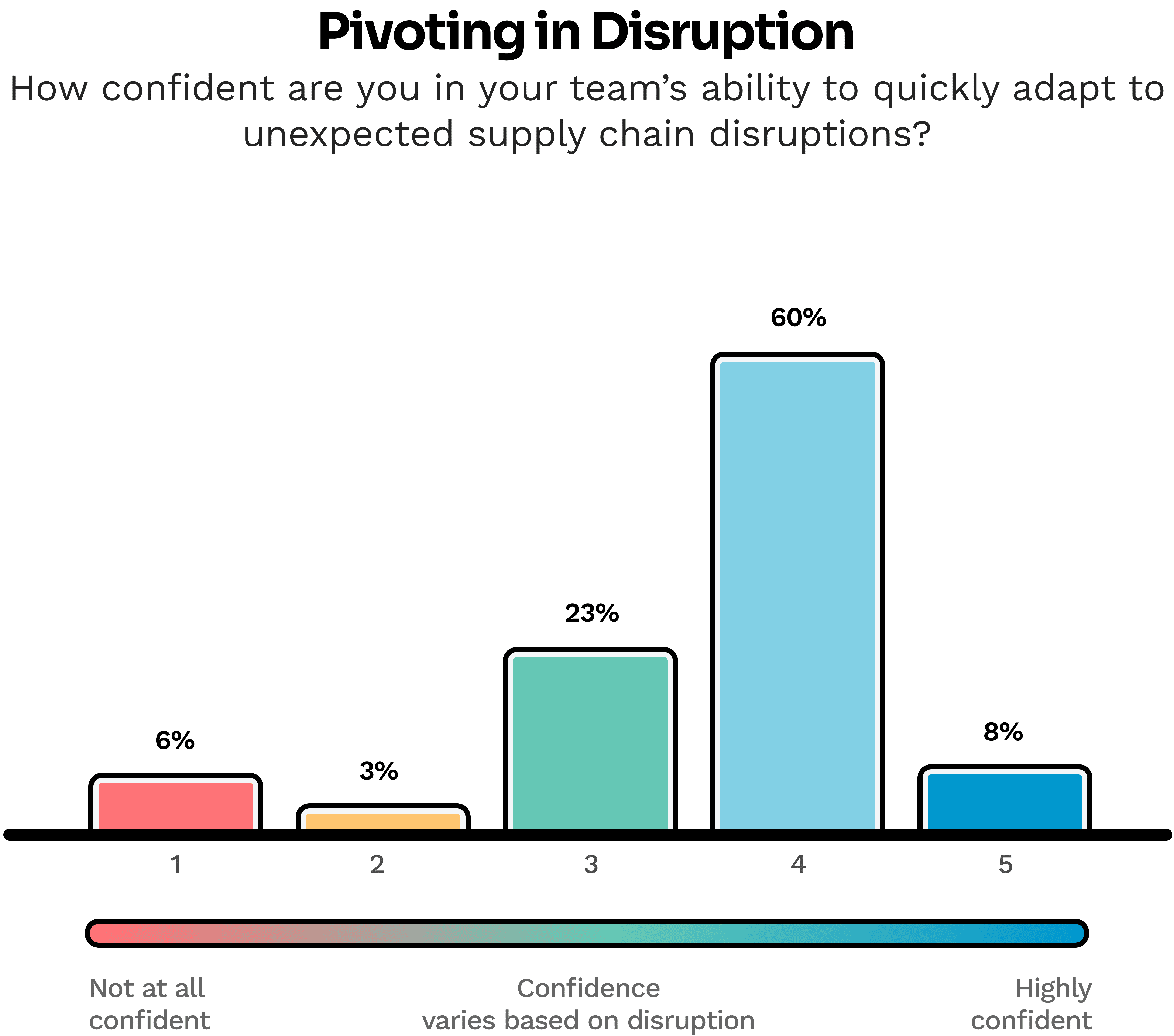
As we see in these survey results, 68% of respondents rate themselves a 4–5 (out of 5) in disruption adaptability… a fairly solid number, assuming this confidence is well-placed and proven. However, nearly one in three fall into “confidence varies,” where readiness ostensibly depends heavily on the type or severity of the disruption scenario… or even worse, they respond “not confident at all.” At best, this points to a team that either has established a pattern of firefighting and workarounds or simply doesn’t have the bandwidth to even consider how they could better prepare for potentially devastating disruptions. Obviously, every business should develop and maintain the type of systemic resilience that is required to survive significant volatility.
Additionally, respondents and our readers who feel confident in their ability to handle disruptions would be well advised to regularly and thoroughly vet that confidence against both historical and theoretical volatility scenarios. The best way to achieve this is with intelligent, dedicated S&OP/Integrated Business Planning (IBP) platforms that enable dynamic forecasting and scenario generation/analysis.
The bottom line is that most business leaders don’t fully understand the impact of, and are truly unprepared for, the types of supply chain disruption, volatility, and change that have grown more prevalent over the past decade. Global supply chains were not designed to be flexible as much as they were designed to be efficient. Over the past 50 years, global and American supply chains have generally worked toward the primary goal of taking costs out of the system. We can see further evidence of this in the survey results discussed above, where 41% of survey respondents chose cost optimization as their top priority for the coming year. Consequently supply chains have been built to (and are prioritized to) run very tight with minimal ability to flex.
When uncertainty and volatility exists, businesses often pull the “more inventory” lever more than they work on optimizing their operating strategy and S&OP protocols. They don’t know what tomorrow will bring, and don’t know what they can do to better prepare for—or truly understand—disruptions, so they tend to just invest in more inventory as a kind of knee-jerk safety response. However, this in itself can cause disruption, and often does.
As we examine the next few sets of responses, other potential problems are brought to light.
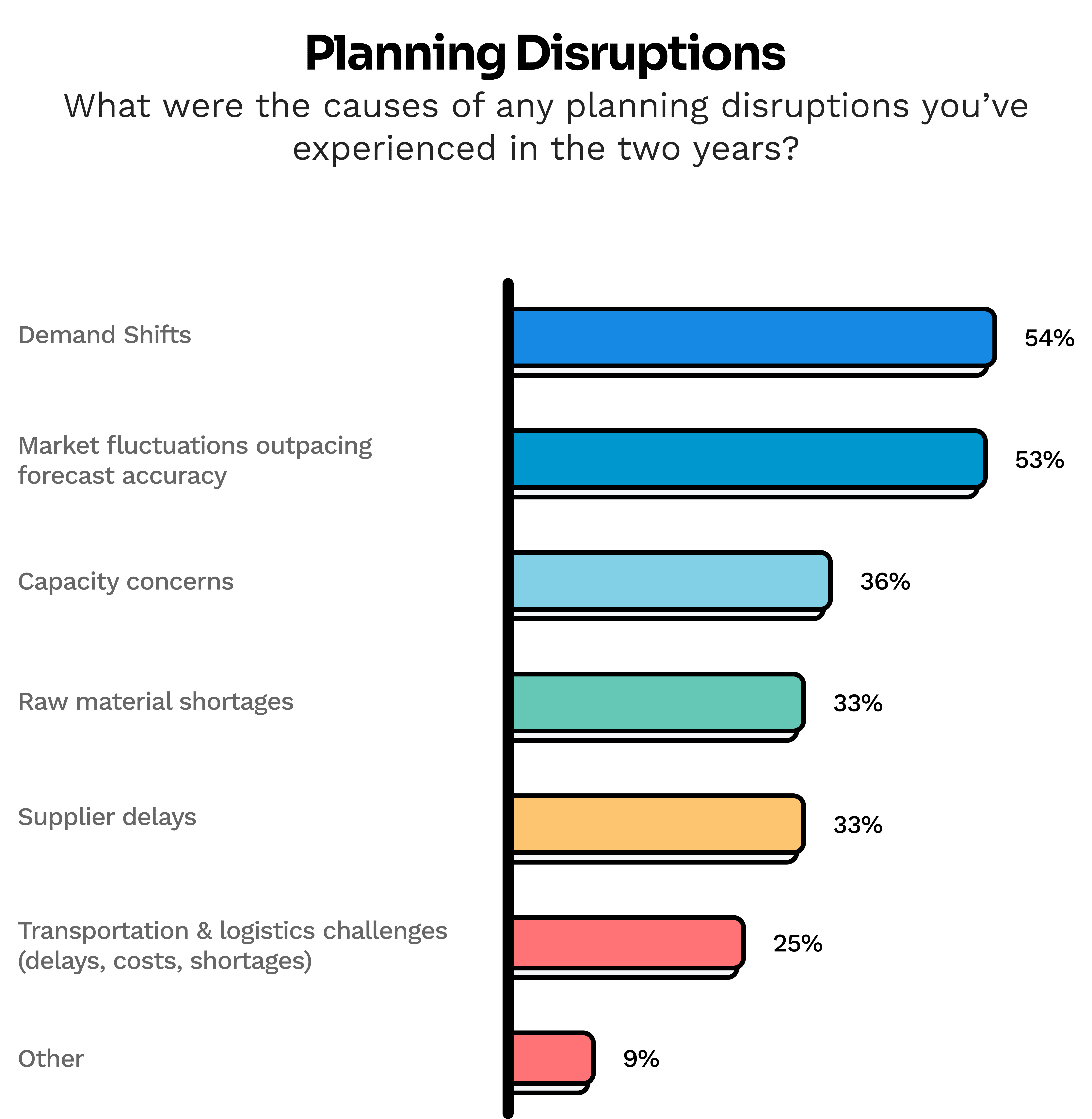
Here we see that volatile shifts in demand along with market fluctuations outpacing forecasting activity are by far the most widespread planning disruptions experienced by survey participants over the past 2 years, at 54% and 53% respectively. But the problems caused by inadequate planning/forecasting and demand resources are not restricted to planning disruptions, as we’ll see in the sections below.
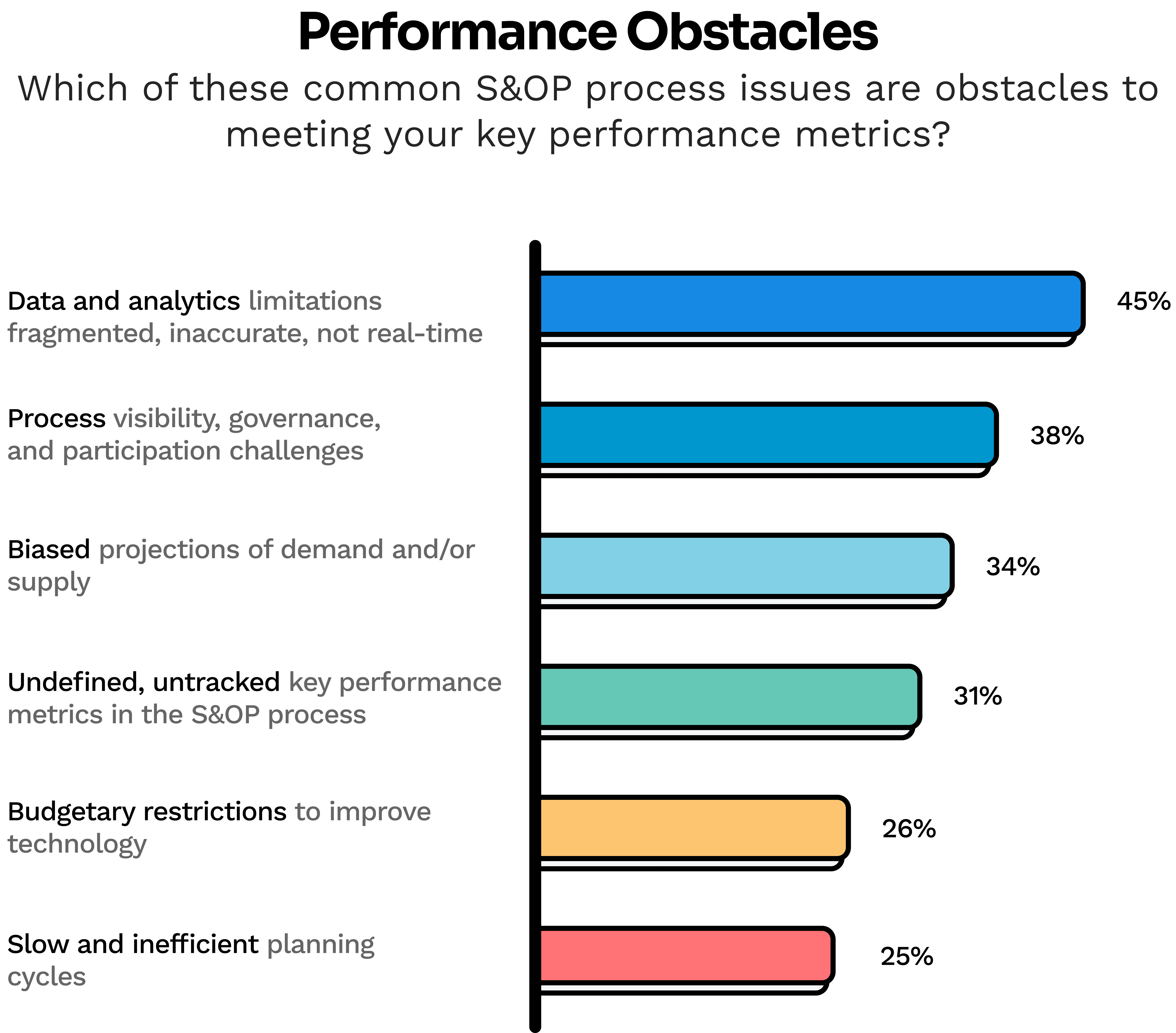
From this graph we can clearly see that supply chain teams and leadership are aware on some level of the limitations and problems caused by inaccurate or outdated data and analytics. By far the most common reported S&OP process obstacle that keeps respondents from meeting KPIs is data and analytics being fragmented, inaccurate, and not real-time, with fully 45% of respondents agreeing.
But there seems to be a disconnect between this core need for coherent, real-time, flexible data/analytics, and those participants responding that inventory/production and logistics process efficiencies are the areas that most deserve their attention.
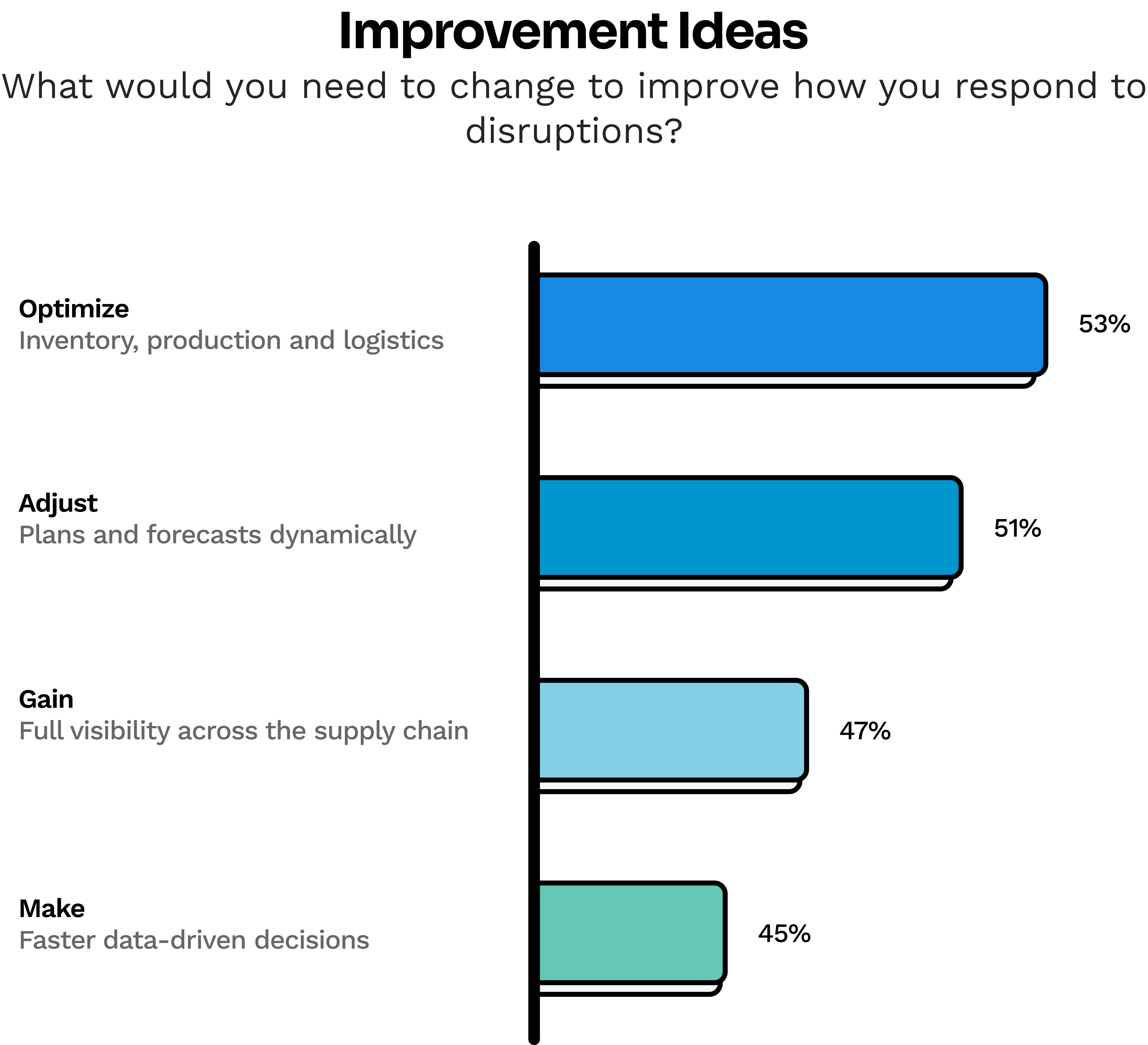
When asked what they would need to change to improve how they respond to disruptions, the most popular response (53%) was to optimize inventory, production, and logistics. While this is indeed an important part of any sensible supply chain disruption response strategy, it’s important that teams don’t make “efficiency” their end-all and be-all when it comes to surviving in a chaotic environment. Additionally, it could be argued that while optimizing these areas in advance of unknown disruptions is nominally proactive, in essence the response can be reactive in nature. How?
Companies may anchor on optimizing efficiency in inventory, production, and logistics because that’s something they feel they have control over in the face of the unknown—an unknown which they don’t believe they can truly understand or prepare more effectively for. They’re essentially reacting in advance to an undefined (and ostensibly nebulous) future threat. It would often be better for the company to take the more effective and profitable course of focusing more attention and resources toward achieving accuracy, speed, and flexibility in the data and analytics that allow real-time, meaningful decision-making. This, in turn, permits the organic optimization in the areas sought above, but with an informed, truly proactive, more profitable, and more resilient process as a result.
There’s a relevant Old West quote attributed to Wyatt Earp regarding the art of surviving a gunfight: “Fast is fine, but accuracy is final.” Obviously the intent is to convey that being super fast on the draw won’t help you win if you can’t hit what you’re shooting at. While supply chain management may sometimes feel like the Wild West these days, it’s certainly not usually a life-or-death situation. However, we might modify Mr. Earp’s maxim for a supply-chain audience something to the effect of: “Efficiency is fine, but flexibility is final.”
Of course, in the real world it’s not a question of one or the other—either all speed or all accuracy, either all efficiency or all flexibility. To achieve the desired results, we need both in the appropriate amounts. But consider that if we double down on efficiency at the expense of flexibility, we may merely grow very efficient at implementing processes, procedures, or plans that are suddenly (and frequently) outdated by the rapidly changing business, social, financial, or market environment we all now work in.
Strongly prioritizing efficiency in inventory, production, and logistics, but at the expense of the ability to adapt and make faster, data-driven decisions truly is false economy, and only looks good for the short term. Without intelligent, adaptable planning and decision-making, a company may soon find it doesn’t have to worry about maximizing inventory or production efficiencies at all… as there won’t be much of a need to maintain inventory in the first place.
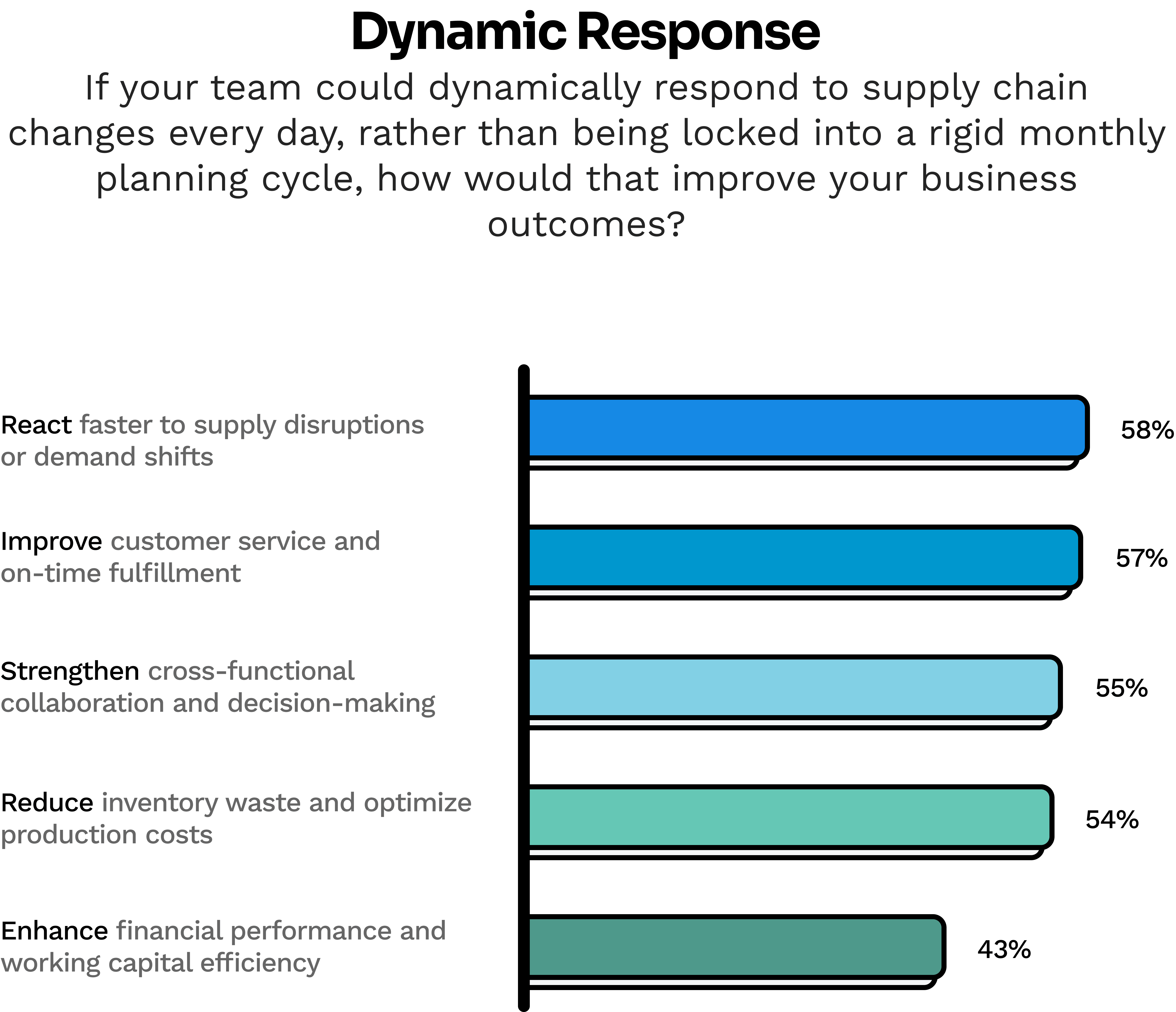
As this graph shows, if intelligent planning could be more flexible and adapt daily instead of monthly, more than half of respondents would expect meaningful gains in disruption response time, service levels, cross-functional collaboration, inventory efficiency, and overall financial performance.
Interestingly though, only 43% make the logical connection between a more flexible, dynamic, and rapid planning process and “enhanced financial performance and working capital efficiency,” even though the above results of reduced production costs, faster disruption response, improved customer fulfillment/satisfaction, and reduced waste would have obvious benefits financially, both in the short and long term.
So, it’s clear that an objective view of the most pressing planning issues, as well as the most common obstacles preventing KPI achievement, exposes the vital need for accurate, flexible, data-driven, real-time, intelligent S&OP capabilities. However, as we’ll see next, that’s not what organizations are prioritizing when selecting tools and platforms.
Today, supply chain management (SCM) teams (and they overwhelmingly own S&OP today, as shown above) consistently report growing pressure to reduce costs while managing volatile demand amid ongoing, unpredictable, and significant disruptions. Yet the survey results shown in the graph below indicate that most are still relying on traditional all-in-one Enterprise Resource Planning systems, Business Intelligence tools, and/or spreadsheets (yes, spreadsheets), with only 13% using dedicated S&OP/IBP platforms.
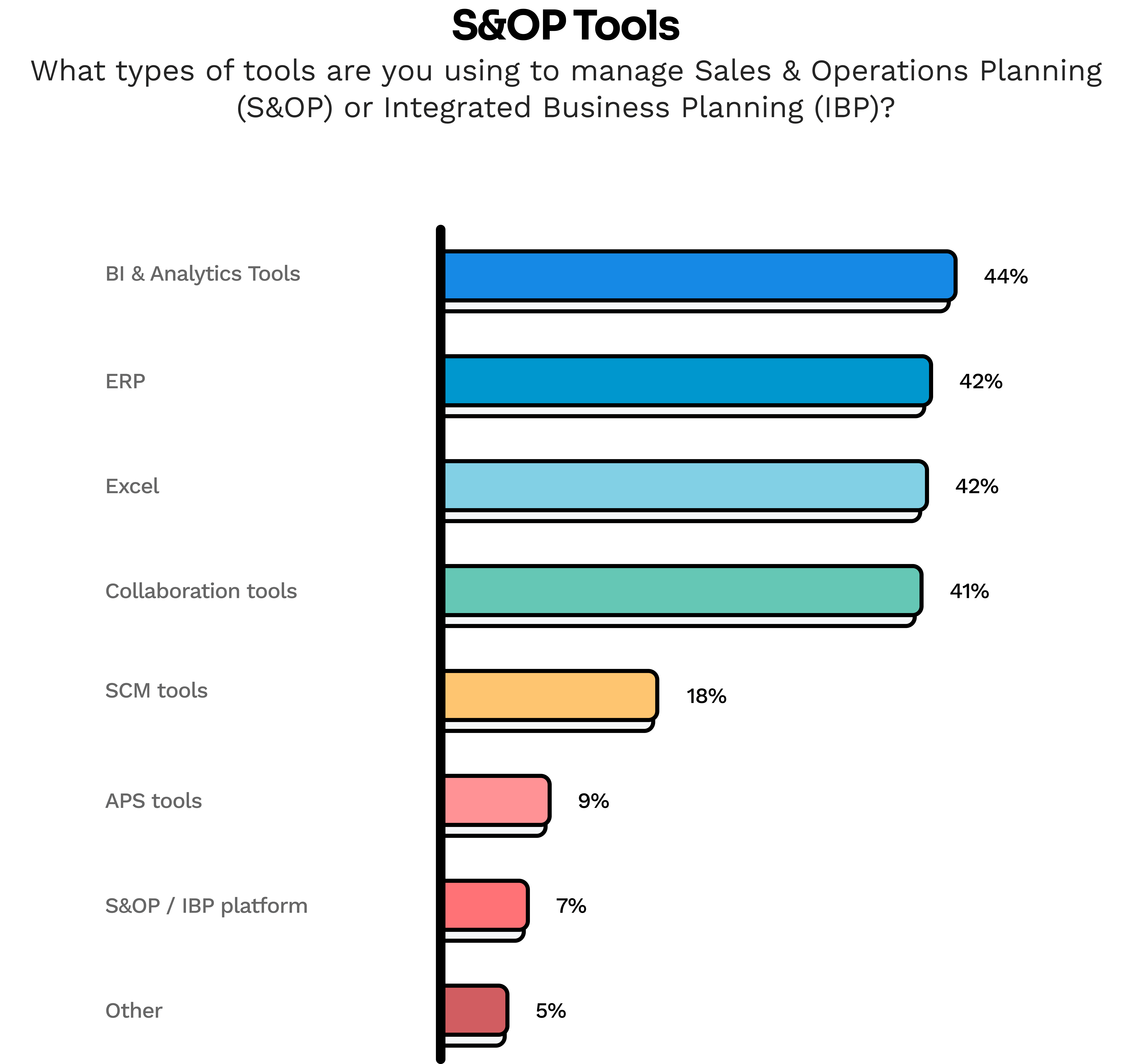
In some ways this isn’t surprising, since BI and ERP systems have been overpromising (and underdelivering) on intelligent S&OP, data, and forecasting capabilities for many years. Interestingly, when it comes to survey participants taking advantage of today’s far-more-capable dedicated S&OP/IBP platforms, cost of entry doesn’t seem to be a significant issue for many, as we can see from the Performance Obstacles graph discussed earlier that budgetary restrictions to improve S&OP technology aren’t significant barriers to reaching KPIs, at only 26% reporting this issue.
This response is somewhat telling, however. For the sake of argument, theoretically, it could be that the remaining 74% of respondents have an unlimited budget regarding improving SCM related technology. However, based on what we’ve seen in real-world situations, and the learnings gathered from the other responses in the survey, we doubt that’s the case. The more likely nugget of truth behind this response is that only 26% of respondents realize that improving SCM tech is important enough to even worry about finding a budget for.
What SC teams and orgs need is the ability to simulate, run more analytics and make more strategic, more informed, and actually useful decisions. This is very difficult with current tools, and particularly with spreadsheets. Despite the advantages of end-to-end visibility, dynamic planning and forecasting, real-time data/analytics, scenario stress-testing, risk management, cross-functional alignment, it may be that many SC teams and orgs are simply not aware of the availability and capabilities of today’s dedicated S&OP/IBP platforms.
It’s clear that effective leaders should focus their efforts on what’s needed to not just survive, but thrive in a tumultuous and unpredictable market: flexible, dynamic planning, end-to-end visibility, optimized inventory and production, and faster data-driven decisions. ORI offers a data and software platform that helps organizations mature their S&OP process by replacing static, spreadsheet-driven planning with a dynamic, collaborative, and decision-oriented approach. Unlike general-purpose tools, ORI brings together data, people, and workflows in a single, intuitive platform that helps teams reduce risk, respond faster to change, align more closely across functions, and make smarter, forward-looking decisions rooted in real-time visibility and scenario planning.


The ORI Excellence Platform is the only software and AI tool purpose-built to help you achieve top-tier sales and operations planning and execution in one place. Reduce risk, manage uncertainty, and increase resilience with ORI.
Get a free demo and find out how ORI's 30 years of experience and best-in-class technology can help you.